Guides › Japanese vintage fakes
Is that Japanese vintage holo real?
Fake Japanese vintage Pokémon holos: what to check, and how to protect yourself
Some fakes of Japanese vintage holo cards now look right at a glance: the holo shimmers, the colors match, the borders are correct. Here is what still gives them away under a loupe, which home tests to skip, and what to do before and after you buy. It covers Japanese vintage holos only.

In short
- Old tells aren't enough. One collector who bought and compared a recent batch reports the holo and colors now look right; the giveaways are in the small print, the dot pattern, the back and the edge.
- Use a loupe and a genuine card from the same era. Compare, don't guess.
- Skip the light test and never rip a card. The first isn't a reliable verdict on holos; the second destroys real cards.
- Inspect the day it arrives. On eBay, if a trading card does not match the listing and the seller does not accept returns, request a return no later than 3 calendar days after the estimated or actual delivery date (eBay).
Covers
Japanese vintage holo cards and era promos, such as the "CD promo" Venusaur, Charizard and Blastoise.
Doesn't cover
Modern English or Japanese sealed product bought from the vetted shops on our Deals pages, or how to authenticate graded slabs. The habits below help everywhere, but the tells are about these vintage cards.
Why these are harder to spot
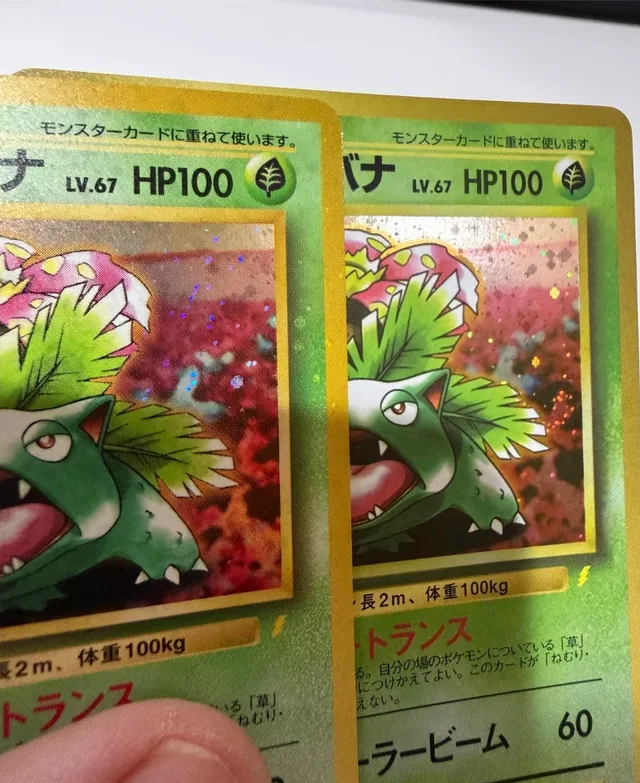
One collector who bought a "CD promo" set and compared it with genuine cards reports that this batch fixed earlier giveaways: no lines in the holo, no plain yellow border, a card feel "extremely similar", and a holo he calls "spot on" (u/GuardianofM). That fits what grading companies see: CGC has caught a fake modern Japanese promo printed on an offset press, the same process as genuine cards, and warns "fakes of this type can be very deceptive" (CGC, 2025).
ICv2 reports that counterfeit Pokémon cards submitted to PSA rose 125% in 2025 (ICv2). We have not found a grading-company figure specific to Japanese vintage cards.
What to check, with a loupe
A jeweler's loupe and a card you know is genuine from the same era do most of the work: grading companies authenticate by close inspection of the print and the card (CGC). The lines in italics are his: on the cards he compared, u/GuardianofM reports these possible warning signs. They describe that group of cards and are not proof by themselves.
- 1The dot pattern. Genuine Pokémon cards are printed in four inks whose dots form a "rosette" under magnification (CGC). Seeing rosettes isn't proof: CGC found a Japanese fake with "a similar rosette pattern" (CGC). Compare dot size and spacing.
ReportedOne collector reports this batch's rosettes are the right shape but smaller than genuine.
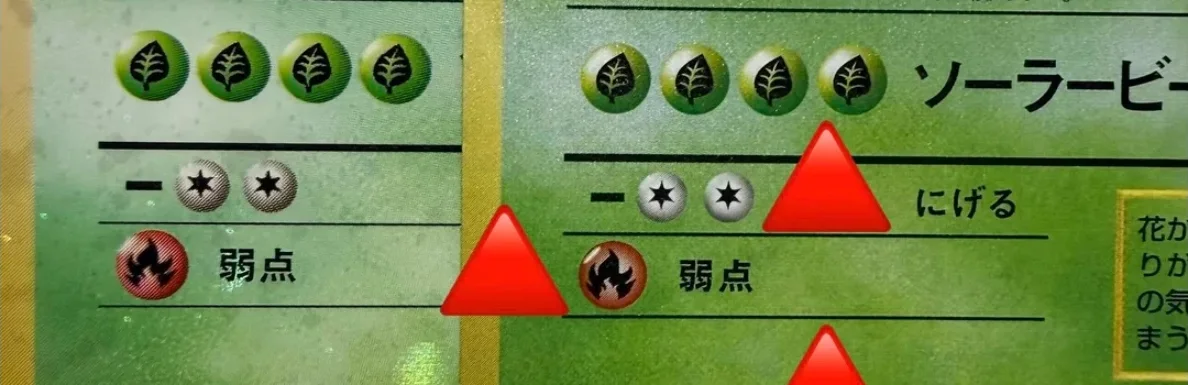
- 2The small print and symbols. CGC caught a 1997–98 Japanese fake by its font and the spacing in the illustrator credit (CGC), and Cardmarket notes fakes "often use different fonts" (Cardmarket). Check every energy symbol and the credit line.
ReportedOne collector reports, on this batch: colorless energy missing its bottom shadow, a white spot instead of a white highlight on the fire energy, and the wrong font in "Illus. Ken Sugimori".
- 3Fine detail. Some fakes reproduce scans, which can leave fine artwork or text fuzzy; CGC describes one whose art is "much fuzzier" than genuine (CGC).
ReportedOne collector reports a fuzzy Pokémon in the evolution box and pixelated print on some cards in this batch.
- 4The back. CGC has caught fakes by a back that was "much fuzzier" than genuine, and Cardmarket notes color saturation often differs (Cardmarket).
ReportedOne collector reports this batch's backs have the right pattern but are too dark.
- 5The edge. A genuine card is layered: CGC lists "blue back, white paper, black core, another white layer" on a genuine edge (CGC). A dark line alone doesn't prove anything: some fakes are glued onto real card backs and end up "almost twice as thick" (same source). Core color alone is not a reliable verdict. One experienced collector observed a whitish-silver-looking core on a Japanese holo promo; compare the edge with a known-genuine card of the same type.
ReportedOne collector reports this batch is thicker, with an obvious black line.
Two tests to skip
Skip
Buying with less risk
Do
- Treat listing photos as a claim, not proof. eBay forbids photos that don't represent the actual item (eBay), but the card in the photo may not be the one that ships. u/GuardianofM reports receiving counterfeit cards after listings showed genuine cards, so inspect the card that actually arrives.
- Pay so you're protected. Use the platform's checkout or PayPal Goods & Services. PayPal's US Purchase Protection may cover a significantly-not-as-described purchase if you file within 30 days of delivery or 180 days of payment, whichever is sooner. Friends and Family payments and items bought mainly for resale are not covered. PayPal may require you to return the item at your own cost (PayPal).
- Buy high-value vintage from sellers with a long, checkable history, and still check the card yourself.
- Consider graded cards, and check the slab. CGC says cards in its holders are authentic unless the label states otherwise; its guarantee provides a 10-year claim period (CGC). Grading isn't foolproof: reports about purported CGC-certified prototype cards (not ordinary Japanese vintage holos) said they appeared to have been printed in 2024 (Kotaku, 2025), and fake labels exist (KIRO 7, 2026). Look up the certificate number on the grader's own site and match the card to its photo.
- eBay's Authenticity Guarantee. In the US, eligible single trading cards sold on eBay for $200 or more, excluding tax and shipping, may be inspected by PSA under Authenticity Guarantee before delivery. Some Authenticity Guarantee purchases are final sale; returns may be limited to shipping damage or a seller's unhonored return policy (eBay).
If a fake arrives
If you receive a fake
- Photograph itFront, back and edge, before it leaves the sleeve. Keep the packaging.
- Open a claim fasteBay: 3 calendar days if the seller doesn't accept returns; otherwise the seller's window. PayPal: within 30 days of delivery or 180 days of payment, whichever is sooner.
- Don't resell itFollow eBay's disposal instructions; never resell a fake.
- Report the listingCounterfeit trading cards are banned on eBay.
Sources and notes
On eBay, if a trading card does not match the listing and the seller does not accept returns, request a return no later than 3 calendar days after the estimated or actual delivery date. If the seller accepts returns, use the seller's stated return window. If there are strong signs that the card is counterfeit, you still request a return, but eBay may not require you to ship the card back. Cooperate with eBay on disposal and do not resell the card (eBay). Counterfeits are banned on eBay, including "unauthorized reprints of trading cards" (eBay). PayPal's US Purchase Protection may cover a significantly-not-as-described purchase if you file within 30 days of delivery or 180 days of payment, whichever is sooner (PayPal). On other marketplaces, use their own claim process.
About the "CD promo" cards
The Japanese "CD promo" Venusaur, Charizard and Blastoise are non-glossy holo promos. They were distributed through a 1998 mail-in trade campaign and later included with the Pokémon Song Best Collection CD in January 1999. Collector sources describe cards from the two releases as indistinguishable (Elite Fourum, PokéZentrum). Their value makes them a target, so they're worth the full check above.
How we checked this
Researched October 15, 2026, from CGC's counterfeit alerts and guarantee, eBay's and PayPal's own policy pages, Cardmarket and long-running collector references. Details marked "one collector reports" come from u/GuardianofM's comparison and haven't been confirmed independently. We don't name or judge any seller. See counterfeit and buyer protection in the glossary.